
A book by Theo Kingsford
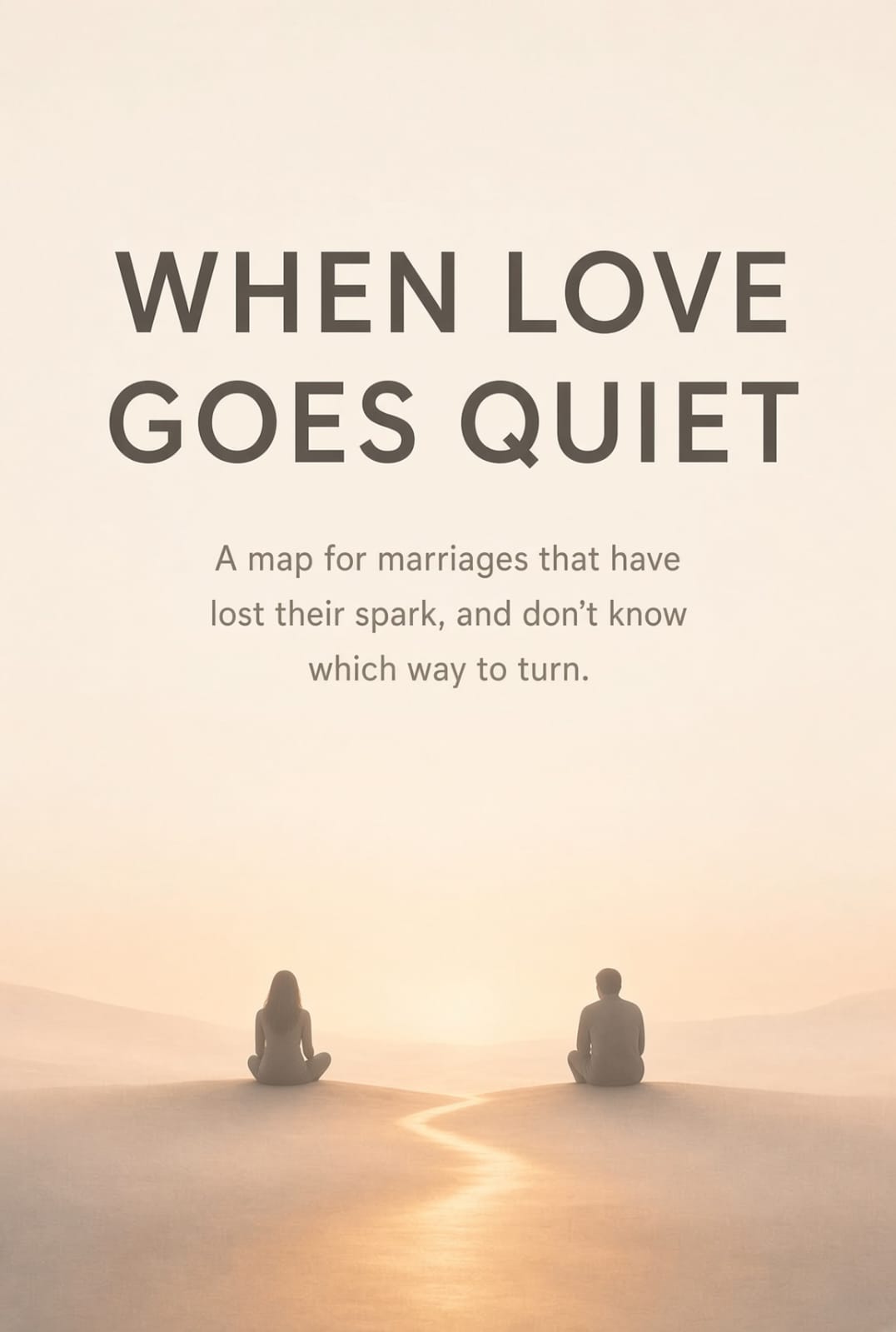
When LoveGoes Quiet
A map for marriages that have lost their spark, and don’t know which way to turn.
Nothing is obviously wrong. And something has gone quiet.
You know the feeling before you have the words for it.
The bills get paid. You’re kind to each other in the kitchen. From the outside it looks like a marriage, because from the outside it is one. And somewhere in the running of it, the talking went — not the talking about the bins and the dentist, but the other kind. The kind you did at the start, in the car on long drives, in bed with the light off, about nothing, for hours.
You still touch. A hand on the shoulder in passing, that stays half a second, and then goes. And you couldn’t say, hand on heart, whether it was reaching for you, or just passing you on the way to the kettle.
And underneath all of it, the question you don’t say out loud — not to a friend, not even fully to yourself, in the odd private moment at the sink, in the car with the engine off:
- “Why am I lonely when we’re together?”
- “Is this it? Is this all there is?”
- “Where did they go — and did I do this?”
You’re not imagining it.
And you’re not making too much of it.


The quiet is not always a marriage dying.
Sometimes it’s a marriage trying to change — and no one ever taught either of you what change feels like from the inside. So you’ve been reading a doorway as an ending.
Two people who have grown together for fifteen years are not finished growing. They can’t be; they’re alive. And when a living thing changes, it goes through a season that looks exactly like loss, and feels exactly like loss from within.
It doesn’t mean you failed. It doesn’t mean they’ve stopped loving you. If anything, it means there was enough alive between you to be changing at all.
A map, not a rescue.
Most books about a marriage like this tell you to try harder, or to give up. This one starts somewhere else.
It won’t promise to hand back the marriage you used to have. It won’t tell you whether to stay or to go — it will refuse, more than once. What it offers instead is a way to read what your own body already knows: how to quiet the fights that were never really about what they seemed, and how to find out, honestly and together, whether the way through leads back toward each other, or cleanly apart.

You may already know this book is for you.
- You feel lonely in your marriage, and you can’t point to anything they’ve actually done.
- You love each other — you’re sure of it — but you’ve started to feel more like roommates than lovers.
- The wanting has gone quiet, on one side of the bed or both, and you can’t say so without it sounding like a verdict.
- You keep arriving at the end of the sentence with nothing in it: “it’s just… I don’t know… it’s—”
- You’re not sure whether you’re grieving something still alive, or quietly finding it may already be gone.

Whichever way it turns out to need to go, something here goes with you.
Right now the weather in your own house goes straight through you. A mood blows in and you’re gone with it, and you come round an hour later somewhere else entirely.
It is possible to stop being blown about like that, and to become someone standing in it — awake, able to see what is actually there instead of what the fear says is there. That is not a promise about your marriage. It’s about you. And nobody can take it from you once you have it.

Read the opening.
Leave your email and I’ll send you the first pages now — and write once more, when the whole book is ready. Nothing else.
Two emails, ever: the opening now, and word when the book launches. Your address stays private, and you can leave in a click.
Thank you. The opening is on its way to your inbox — take your time with it.